Benacre
The Darling Buds of MayBenacre is the strawberry-growing field where the Larkins’ seasonal economy takes practical shape: pickers bend among rows of straw, baskets pass through a central tent, and the day’s harvest can amount to more than a ton. The place is at once a workplace and a measure of change. Its abundance sustains the family in the present, even as Pop warns that disease is bringing the strawberry trade toward an end.
Setting and Seasonal Work
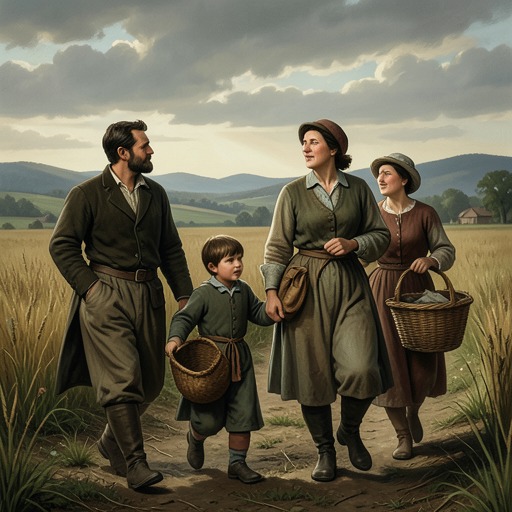
The field first appears in a broad agricultural landscape, passed by truck between orchards whose branches are pink in the sunlight. Fresh yellow straw lies in long rows, a sign that the ground is being prepared for strawberries. Pop slows the truck and invites the family to join the picking; the scene makes the harvest part of the Larkins’ ordinary family calendar rather than an isolated excursion.
That calendar extends well beyond strawberries. June brings the picking, followed by cherries before the month ends and more cherries through July. In favorable summers apples may begin before August, alongside early plums and pears; apples return in August and September, while hops are gathered in September and potatoes in October. Strawberries are especially valuable to a large family: the book gives a possible earning of fifteen pounds a day from that crop alone. Benacre therefore belongs to a cycle of work in which weather and ripening dates shape both household activity and income.
The Picking Field and Its Workers
When Mr Charlton follows Mariette and the family into the field, he encounters a crowded workplace rather than an empty rural prospect. Twenty or thirty women and girls, with a few men among them, are already picking along the straw-covered alleys. Their shirts and blouses form lines of varied color across the field, while a green canvas tent stands in the middle, piled around with fresh white chip baskets.
The tent organizes the harvest as well as offering Mr Charlton a refuge from the heat. After he tries picking, he is directed there to have baskets weighed and checked. Pop introduces him to the foreman, Mr Jennings, as an office worker from the tax business; Mr Jennings quickly offers him the weighing and recording job, which frees him from strenuous picking. The tent thus links the physical labor in the rows to the counting and handling of the crop, and gives Mr Charlton a vantage point from which to understand the scale of the operation.
Heat, Yield, and Observation
The field’s abundance is accompanied by punishing weather. Mr Charlton arrives under a sun already described as unusually hot for May, following the hottest May 30 in forty years according to the newspapers; the day is expected to be hotter still. He finds picking difficult and longs for a cool place beneath the chestnut saplings. Later, the heat changes the workers’ appearance: many women remove their blouses and shirts and continue in bodices or brassieres. The episode presents the labor as bodily and exposed, not merely as a picturesque country activity.
From the weighing tent, Mr Charlton adds up the strawberries passing through it and is astonished to find that he has checked in more than a ton in one day. The figure gives material weight to the Larkins’ talk of the strawberry trade as a source of earnings for the pickers. His trained mind immediately turns from the quantity to its tax implications, and he expects Pop to know the answer. Benacre makes the connection between harvest, cash, and the family’s uneasy engagement with taxation concrete without reducing the work to figures alone.
Disease and the Prospect of Decline
The field’s early-season activity stands against Pop’s later judgment that the strawberry business is nearly finished. He names disease and says that the Sovereigns, Climaxes, and Huxleys are finished; soon, he predicts, strawberries will be unavailable everywhere. He expands the warning from the local growing district to every district and estimates that the trade will be over within two years. Benacre is thus associated not only with a working harvest but with the threatened disappearance of the livelihood it represents.
That contrast gives the location its larger significance. The yellow rows and tonnage in the tent show a crop being gathered on a substantial scale, while Pop’s account of disease places the same agricultural world on a declining course. Seasonal abundance is real, but it cannot guarantee continuity: the family’s practical knowledge of crops and picking must reckon with changing conditions that may close the very field on which its work depends.